

Iron Ore Processing : Flow charts
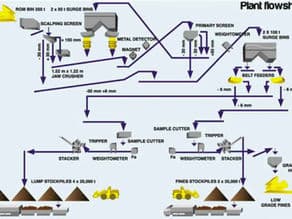
Iron ore is a key ingredient in making steel. In fact, about 98% of the iron ore that's mined goes into steel production. There are two main methods for steelmaking: the blast furnace-basic oxygen furnace (BF-BOF) method and the electric arc furnace (EAF) method. Most global steel is produced using the BF-BOF method.
Types of Iron Ore
Iron ores containing high hematite concentration (over 60% iron) are classified as "natural ore" or DSO (Direct Shipping Ore) and can be used directly in BF-BOF steelmaking. Lower-grade ores require extensive crushing and screening to separate iron from waste gangue minerals.
Iron ore operations use multiple crushing and screening stages to separate materials by size rapidly. The goal is early recovery of valuable lump products (6.3 mm to 31.5 mm) over lower-value fines (< 6.3 mm).
Case Studies & Global Flowsheets
1. Rio Tinto Iron Ore Processing Plants
Pilbara, WA (Dry Processing)Two-stage crushing: Jaw crusher for primary, Cone crushers for secondary. Three-stage screening (scalping, primary, and product separation for lump & fines).
Three-stage crushing: Gyratory crusher for primary, Cone crushers for secondary & tertiary. Two-stage screening. Low-grade ore passes through wet plant beneficiation.
2. BHP Newman Iron Ore Handling Hub
Newman, WA (Blending Hub)- Crushing & Screening: 3 tertiary crushers, 5 scalping screens, and 8 product screens.
- Scalping & Separation: Scalping screens remove fines before tertiary crushing; product screens separate lump and fines post-crush.
- Blending Strategy: Ores from satellite pits are blended in a coarse ore stockpile prior to processing for product consistency.
3. Roy Hill Operation
WA (Wet Processing & Beneficiation)- Crushing Stations: 3 primary/secondary crushing stations handling 5,000 TPH each.
- Wet Scrubbing: Scrubbing and wet screening remove clay contaminants and upgrade ore quality. Oversize ore (>40 mm) is routed to tertiary crushers.
- Stockpiling Fractions: Lump (8–40 mm), Fines (1–8 mm), and Micro-Fines (<1 mm).
4. Vale S11D Project
Carajás, Brazil (Dry Modular)- Sticky Ore Solution: Deployed double-deck eccentric vibrating screens engineered for high-humidity environments.
- Dry Screening Selection: Opted for dry screening over wet methods to eliminate tailings dams and lower CapEx.
5. Mobile Crushing & Screening Plants
Flexible & ScalableMobile systems enable fast setup and relocatability for small-to-medium satellite deposits, drastically reducing haul truck distances and initial capital requirements.
Call +91 82409 38968 to Get a Quote for Iron Ore Crushers
Discuss custom plant designs, dry/wet screening solutions, and mobile crushing systems with an HPPA expert.
Have questions about your stone crushing project?
Our HPPA engineering experts are here to help you select the perfect equipment configuration and plant layout for your capacity targets.


